Engineering & products
Samsung’s All-AI Factory Push: What It Means for Indian Manufacturers
Samsung’s AI factory move shows where manufacturing is headed: connected machines, smarter decisions, and less downtime.
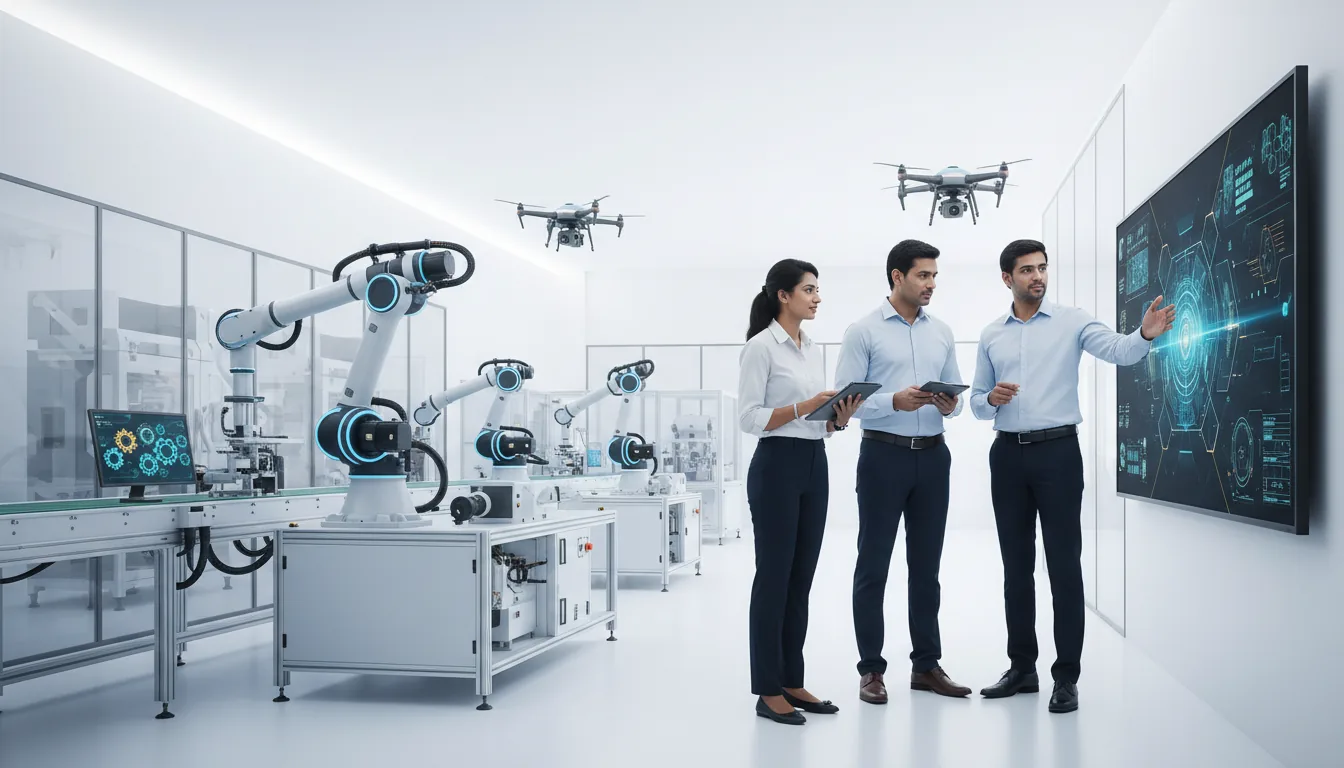
Samsung’s all-AI factory push is a clear signal that smart factory solutions are no longer a future concept—they are becoming the operating model for serious manufacturers. For founders and plant leaders in Ahmedabad, Surat, Rajkot, and across Gujarat, the real question is not whether AI will enter the factory, but how quickly it can improve uptime, quality, and margin.
Indian manufacturers face a familiar mix of pressure: tighter delivery timelines, rising expectations on consistency, skilled labor gaps, and the constant cost of downtime. That is why smart factory adoption should be treated as a competitive advantage, not just another tech upgrade.
Why Samsung’s all-AI factory push matters for Indian manufacturers
When a global manufacturer moves from isolated automation to AI-driven operations across the plant, it sends a strategic message. AI is no longer limited to dashboards or experiments in a single line; it is being used to coordinate production, quality, maintenance, and decision-making at scale.
For Indian factories, especially in Gujarat’s engineering, textile, chemical, packaging, auto components, and process manufacturing sectors, this matters for practical reasons. Better labor efficiency, fewer defects, lower downtime, and faster response times can directly improve competitiveness in domestic and export markets.
The shift also changes how leaders should think about technology budgets. Instead of buying disconnected tools one by one, manufacturers can build an operational layer that connects machines, people, and business systems. That is the core promise of digital transformation India is moving toward.
What a smart factory actually includes
A smart factory is not just a machine with sensors attached. It is an integrated system where industrial IoT, software, analytics, and workflows work together to create visibility and action.
At the core, you usually find:
- Industrial IoT sensors for temperature, vibration, energy, pressure, cycle counts, or machine state.
- Machine monitoring system software that tracks uptime, downtime, alarms, and production output.
- Data dashboards for plant managers and leadership teams.
- AI analytics to detect patterns, anomalies, and bottlenecks.
- Connected workflows that route alerts, approvals, and maintenance tasks to the right people.
On top of this layer, AI agents and an enterprise AI assistant can help teams search SOPs, summarize incidents, draft reports, and answer operational questions faster. That is where AI stops being a buzzword and starts saving time on the shop floor.
The difference between isolated automation and a true smart factory is integration. A standalone attendance tool, a separate maintenance log, and a disconnected inventory sheet may each solve one problem. But a smart factory architecture connects them into a single view of operations.
High-impact use cases for Indian manufacturing plants
For most factories, the best starting point is not a large transformation program. It is one high-value use case that solves a painful operational problem and creates a visible return.
1. Machine monitoring system
A machine monitoring system gives real-time visibility into uptime, downtime, output, and anomalies. This helps operations teams see where production is slowing, which machine is underperforming, and when intervention is needed.
For Ahmedabad and Gujarat manufacturers, this is especially useful in multi-shift environments where issues often go unnoticed until the end of the day. Visibility alone can improve accountability and response speed.
2. Predictive maintenance IoT
Predictive maintenance IoT uses sensor data and analytics to identify failure patterns before a machine stops working. Instead of waiting for breakdowns, maintenance teams can act earlier and reduce unplanned downtime.
This approach can also extend equipment life by reducing stress and enabling more planned servicing. For plants with expensive or hard-to-replace machinery, that can be a meaningful operational advantage.
3. RFID inventory system
An RFID inventory system improves raw material tracking, WIP visibility, and warehouse accuracy. It reduces manual errors and helps teams know what is available, where it is, and how it is moving through the plant.
That matters when production depends on timely material availability. Inventory blind spots often create hidden delays that look like machine problems but are actually coordination problems.
4. Workflow automation
Workflow automation can route quality checks, maintenance tickets, incident alerts, and approval requests without manual follow-up. It reduces dependency on WhatsApp chains, paper logs, and memory-based coordination.
When teams move faster on exceptions, the factory becomes more predictable. That predictability is often more valuable than flashy automation.
Where AI and custom software create the most value
This is where custom software development India becomes critical. Off-the-shelf tools can be helpful, but manufacturing environments usually need software that fits existing machines, plant processes, reporting needs, and business systems.
The highest value often comes from connecting machine data with ERP, CRM, inventory, and quality systems into one operational layer. That gives founders and plant heads a single source of truth instead of fragmented reports from different departments.
Business dashboard software can then present the right metrics to the right people. A founder may want line-level profitability and downtime trends. A plant manager may need shift performance and maintenance backlog. A supervisor may only need live alerts and action items.
AI can also be layered into knowledge access. A RAG platform and AI knowledge base can help teams query SOPs, maintenance manuals, machine troubleshooting guides, and quality instructions in natural language. That reduces dependency on a few experienced people and helps new operators ramp faster.
More advanced agentic AI and AI automation for business can speed up decision-making by summarizing issues, recommending next steps, and creating tickets or reports automatically. In practice, this reduces the coordination load on operations leaders.
Smart factory value is not only in collecting data. It is in turning that data into faster action, fewer errors, and better decisions across the plant.
Smart factory adoption roadmap for Ahmedabad and Gujarat manufacturers
The smartest way to begin is small and focused. Start with one line, one plant, or one process before trying to digitize everything at once.
Before implementation, assess four things:
- Data readiness: What machine and process data is already available?
- Sensor availability: Which assets need retrofitting?
- Network reliability: Can the plant support stable connectivity?
- Process ownership: Who will act on alerts and insights?
For most manufacturers, the best first wins are downtime reduction, inventory accuracy, and maintenance response time. These are measurable, practical, and easier to align across operations and leadership.
Just as important is choosing the right partner. A good technology partner should handle strategy, software, IoT integration, and implementation—not just sell a tool. In practice, that means working with a team that can think like a product builder and a factory operator.
Common implementation challenges and how to avoid them
Smart factory projects usually fail for avoidable reasons. The technology is rarely the real problem; the gaps are usually in integration, ownership, or adoption.
Legacy equipment integration
Many plants in India run reliable older machines that were never designed for connectivity. Retrofitting with sensors, gateways, and middleware can bridge old equipment with new systems without replacing the entire line.
This is often the most practical path for Indian factories. It keeps capital expenditure under control while still unlocking visibility.
Data silos
Machine data, production data, and business data often live in separate systems. That makes reporting slow and decision-making inconsistent.
The fix is a unified platform that centralizes operational data and makes it usable across departments. Once teams trust the same numbers, coordination improves quickly.
Change management
Operators, supervisors, and maintenance teams need training and context. If a smart factory system feels like surveillance or extra work, adoption will stall.
Make the workflow easier, not harder. Show each team how the system helps them save time, reduce rework, or avoid emergencies.
Vendor risk
Many projects break because the scope is vague or the architecture cannot scale. Founder-led execution, clear milestones, and a modular approach reduce that risk.
This is also where a team like Corp8 AI can be relevant if you are looking for applied AI and operational software thinking rather than generic tool deployment.
What manufacturers should ask before starting a smart factory project
Before you invest, ask the questions that connect technology to business outcomes.
- Which process has the highest ROI if automated first?
- What data is currently available from machines, operators, and systems?
- Should the solution be custom software, SaaS, or a hybrid platform?
- How will the project integrate with ERP, CRM, inventory, and reporting tools?
These questions help you avoid buying technology that looks impressive but does not improve operations. The best projects start with a business problem and end with measurable operational gains.
For many manufacturers, the right answer is a hybrid approach: custom software where the plant has unique needs, and SaaS where standard workflows are enough. That balance keeps implementation practical and scalable.
Conclusion
Samsung’s AI factory direction is not just a headline. It reflects a broader shift toward connected, intelligent manufacturing where software, sensors, and AI work together to improve outcomes.
For Ahmedabad and Gujarat manufacturers, this is the right moment to move from curiosity to action. Start with one operational pain point, build a focused smart factory use case, and expand only after the system proves value on the floor.
Work with Techynix - book a call to scope your AI, software, IoT, EV or brand project
If you are evaluating smart factory solutions, IoT for manufacturing, or an AI-enabled operations layer, the opportunity is to build something practical, integrated, and scalable.
That is how manufacturers turn digital transformation into real factory performance.
Frequently Asked Questions
What are smart factory solutions in manufacturing?
Smart factory solutions combine industrial IoT, machine monitoring, AI analytics, and connected workflows to improve visibility, uptime, quality, and decision-making on the shop floor.
How can AI help Indian manufacturers?
AI can help Indian manufacturers reduce downtime, improve quality checks, automate reporting, support maintenance teams, and make production decisions faster with better data.
What is the first step to building a smart factory?
Start with one high-impact process, assess available machine data and sensor readiness, and define the business outcome you want to improve first, such as downtime or inventory accuracy.
Can older factory machines be connected to smart factory systems?
Yes. Older machines can often be retrofitted with sensors, gateways, and middleware so they can share data with modern smart factory platforms.
Why is custom software important for smart factories?
Custom software is important because factory processes, machines, and reporting needs are often unique. It helps connect ERP, CRM, inventory, and shop-floor data into one operational layer.
Written by Niraj Ojha
Niraj Ojha is a multidisciplinary engineer, founder, and product builder working across electronics, automotive engineering, manufacturing, software, and AI.
More writing
IIT-Gn AI in Transportation Tie-Up: EV Startup Impact
IIT-Gn’s AI in transportation push signals a bigger market for EV, fleet, and logistics software in India. Ahmedabad founders can turn transport data into prod…
On-Prem AI for EV Retrofitting in India
India’s EV retrofit market demands secure, compliant AI. Corp8 AI delivers on-prem AI solutions for EV diagnostics and repair, prioritizing data sovereignty an…
GPT-5.6 and ChatGPT Work for Business Automation in India
AI automation for business is moving from chat interfaces to agents that can execute work across tools, documents, and teams.